The Cinematic Enfant Terrible
Rule Breaking Children and Teenagers in French Cinema
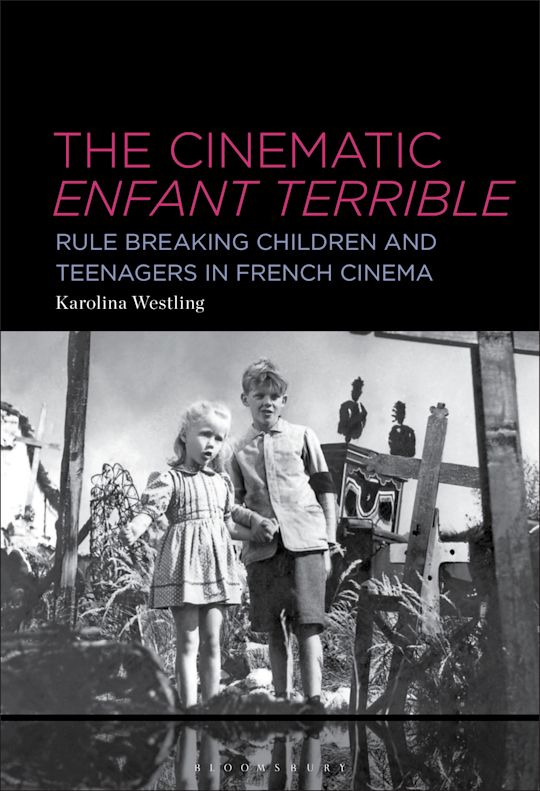


The Cinematic Enfant Terrible
Rule Breaking Children and Teenagers in French Cinema
Buying pre-order items
Ebooks and Audiobook
You will receive an email with a download link for the ebook or audiobook on the publication date.
Payment
You will not be charged for pre-ordered books until they are available to be shipped. Pre-ordered ebooks will not be charged for until they are available for download.
Amending or cancelling your order
For orders that have not been shipped you can usually make changes to pre-orders up to 72 hours before the publishing date.
Payment for this pre-order will be taken when the item becomes available
- Delivery and returns info
-
Free UK delivery on orders £30 or over
Description
The Cinematic Enfant Terrible is a groundbreaking study of rule breakers in French cinema.
The book approaches the concept of the enfant terrible in the literal sense of the term – young people labelled 'terrible' (awful) by the adult generation. It explores a rich cinematic tradition from Jean Vigo's Zéro de conduite (1933) and François Truffaut's Les Quatre cents coups (1959), to Catherine Breillat's 36 fillette (1988) and Ladj Ly's Les Misérables (2019). The book encompasses the cinematic enfants terribles across age groups and genders, addressing the differences between unruly boys and rebellious teenage girls. The early post-war focus on juvenile delinquency and sexual provocations diversifies into filles fatales and angry girls, but also precarious boys and parents terribles.
The book charts the evolution of the enfant terrible concept from a negative label to a sympathetically-viewed figure of anti-authoritarian resistance, reflecting the changing position of children within the family in post-war France. The films address the ethical paradox of democratic upbringing – the dilemma of raising children to become obedient individuals with a mind of their own. The asymmetrical relationship between children and parents is seen as a tacit family contract that highlights the importance of an intergenerational perspective for the understanding of generational conflicts.
Rebellious children and teenagers on screen are seen in the light of wider social transformations. The book clarifies the interplay between individual protests and cultural currents such as existentialism, feminism and ethnic conflicts. This book will be of interest to scholars and students of French culture and cinema, childhood and youth studies, gender studies and cultural studies.
Table of Contents
Acknowledgements
Introduction
1. The Liberation of Forbidden Games
2. The Unruly Boy and the Failed Family Contract
3. The Terrible Teenage Girl and the Patriarchal Contract
4. The Empowerment of the Terrible Teenage Girl
5. Rule Breaking in the Banlieue
6. Highlighting Broken Family Contracts
Conclusion: Is This the End of the Enfant Terrible?
Bibliography
Websites
Filmography
Appendix: Enfants Terribles in French Cinema, 1945-2012, an Indicative Filmography
Product details

| Published | 21 Jan 2027 |
|---|---|
| Format | Paperback |
| Edition | 1st |
| Pages | 288 |
| ISBN | 9798765105474 |
| Imprint | Bloomsbury Academic |
| Illustrations | 21 bw illus |
| Dimensions | 229 x 152 mm |
| Publisher | Bloomsbury Publishing |
Reviews

ONLINE RESOURCES
Bloomsbury Collections
This book is available on Bloomsbury Collections where your library has access.
Related Titles