“I could very easily have filled two or even three paperbacks with the events of this period”

- Share
Words by Simon Turney | 03 Sept 2026
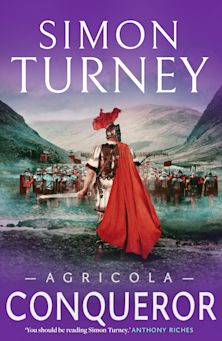
Agricola: Conqueror is the epic conclusion to the series by Simon Turney that follows the story of Agricola, one of Ancient Rome's most epic figures. Vivid, thrilling and historically authentic, we caught up with Simon Turney on his experience writing, researching and concluding this unmissable series.

In Agricola: Conqueror we return to the world of Agricola and his exploits in Rome. How has the process of crafting this character over the course of four books been? What is your favourite part of writing Agricola?
Actually, since I wrote a non-fiction biography of Agricola a few years earlier, I know his life and his world backwards and inside out, so crafting the character was more or less already done for me. All I did was bring him to life, and that is also my favourite thing: having been able to take a real character with a recorded history and breathe life into him so that he can become a character for readers to enjoy the way I already did.
Did you uncover any new or surprising historical details about Agricola while researching this instalment?
Actually, no. Because I have already researched Agricola's life so thoroughly, even touring Scotland to visit the sites with which he is connected, writing book four involved no new research. However, when involved in my original research for his biography, I marvelled at just how close Scotland came to being a Roman province. I even stood in the northernmost Roman fort in the world, at Stracathro, and knew he had stood on the same spot. That gives you shivers.
How do you balance historical accuracy with storytelling pace?
I'm not sure how to answer that, to be honest. I try to maintain historical accuracy as far as is possible in everything I write. Pace simply comes from the way the story is told, not from what the story contains.
What has it been like bringing Agricola’s story to its conclusion—was it harder or more emotional than you expected?
The hardest thing, without a doubt, was keeping it to a single book. I could very easily have filled two or even three paperbacks with just the events of this period. In fact, the saving of the Ninth in the glens is probably worth a book of its own. It was paring it down to fit in one volume without missing anything out or making it feel cramped. The sad thing came at the end. I don't want to say why in case it ruins it for readers, but there was a moment, yes...
If you could meet Agricola in person, what would you most want to ask him?
So many things, but the three that really leap out at me are how he actually felt about the emperor Domitian. Tacitus villainises him in his account, but there are hints that Domitian was actually very good with his generals, and especially Agricola. I suspect Domitian's damned reputation might be revised a little if we could hear what Agricola had to say on the matter. Then there was how it felt to learn that his conquest had been let go and Scotland abandoned. And thirdly, I would love to hear an account of the Battle of Mons Graupius from the horse's mouth.
What do you hope readers take away from Agricola: Conqueror and the series as a whole?
The important thing is that they enjoyed it. Beyond that, if they learned anything of the general and his times, then the books are worthwhile, and if they come away with a new respect for Rome's greatest general, then my job is done.

This thrilling Roman adventure novel sees Agricola return to the scene of his greatest exploits, but to achieve glory he must vanquish his greatest foes yet.
Books by Simon Turney